Why I Didn’t Quit My Toxic Jobs (Part 1)
In my recent blog posts, I’ve talked about what triggered my career pivot from teaching to IT and IT to coaching. There were things I loved about working in IT, yet I was burned out, bored out, or both for more than half of my career.
I was climbing the corporate ladder, working 14-hour days, turning around low performing departments, pushing through large projects with a skeleton staff. It looked great on paper, but felt bad in my body. I was often angry and resentful, especially when management made decisions that seemed to make no sense to anyone doing the actual work.
Even when the stress sent me to the ER with symptoms of a heart attack, I still stayed at those jobs much longer than I should have. Stayed in roles that didn’t fit with organizations that no longer aligned with who I was. I kept thinking I could make it work if I just got a different title or worked for a different company.
And I kept doing it.
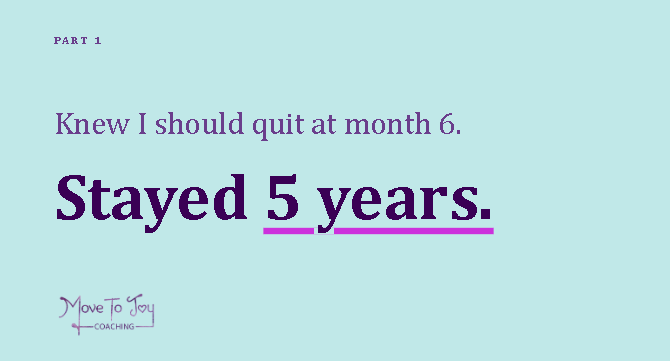
The best example is an organization I stayed with for 5 full years, even though I knew within 6 months it wasn’t a good fit.
The first sign was that my direct manager left about 3 months after I started. Not unusual. But I applied for his position because I was highly qualified for it, and so did another woman who had worked there over 5 years. Instead of hiring either of us, they brought in a man with no industry experience and fewer credentials.
I stayed anyway, even though I knew it was stupid. The company had just shown me that their “we develop our people and promote from within” was just lip service.
Fast forward 3 years in this same company. There was a role I really wanted. I had told my manager and my director that I wanted the position if it ever came open. When the role unexpectedly became available, I asked about it and they were “undecided” on the next step. Then they didn’t advertise the position at all. They just brought in someone from outside. So I not only didn’t have a chance at the job, the fact that I wanted it was completely ignored. And this time they violated their own written policy about advertising positions inside the company for 5 business days. I should have taken that as a sign to leave. But I made the mistake of staying - again.
I was obviously slow to learn, because it happened a third time with this same company. I told them I wanted a position they were considering creating. They never posted it internally, but put it out externally - while I was on vacation! A coworker texted me that they saw it posted, otherwise I would have missed the application window. You already know what happened: I didn’t get the position. But I did finally start looking for another job.
Over and over in my career, I stayed when I knew I should leave. I’d have that knot of dread in my stomach driving into the office because there were leadership changes that set off my spidey senses. I would put in lots of extra hours because the organization had unrealistic expectations of staff, which left me exhausted to the point of skipping workouts and social events that I used to love. I’d be unable to sleep at night from the stress of second guessing myself and having to watch every word because I was in a low-trust environment. And I was always worried that I would be fired or let go, so I was constantly on edge.
So why did I stay so long? I’d tell myself: “you have to stay because job-hopping doesn’t look good on a resume”. I’d stay because “I would be stupid to leave a secure job in the current economy” (and it didn’t matter what the current economy actually was!) I’d stay because I wanted the steady salary, even when I was paid under market value. I’d stay because what if what I tried next didn’t work out, then what would I do? I would really regret it - or so I thought.
In Part 2, I’ll share what finally broke the pattern.