You Don’t Have a Strategy Problem…
You Have a Strategy Problem.
What it takes to actually design a career that's yours.
There's a particular kind of exhaustion that high performers know well. It's not the tired you feel after a sprint. It's the tired you feel when you've been sprinting in the wrong direction for years — and the finish line keeps moving.
You've done everything right. Strong reviews. Solid reputation. Steady paycheck. And still, quietly, persistently: something feels off.
That feeling isn't ingratitude. It's information.
The Effort Trap
High performers don't stall because they stopped trying hard. They stall because effort became the entire plan.
This is the trap I see constantly with women in corporate IT, Finance, and the Sciences. They're excellent at execution. They've built careers on doing more, doing better, doing faster. And so when something goes wrong — when burnout sets in, when a role starts to feel hollow — the default response is to try harder. Take on more. Push through.
But what if trying harder is exactly the wrong move?
Take Danielle — a software engineer at a large tech firm who had done everything right. She'd made two job changes. New companies, new teams, fresh starts. Same result: the burnout and stress she'd left behind followed her to each new role like a shadow.
Her problem wasn't effort. It was alignment.
She was searching for a better job when what she needed was a better fit — work that matched who she was now, not what had excited her ten years ago. No amount of effort was going to solve a strategy problem.
When the Cycle Follows You
The most common career mistake isn't failing to work hard enough. It's changing the scenery while keeping the cycle.
You take a new job. The commute is different. The logo on your badge is different. But within six months, the same patterns emerge: the same kinds of frustrations, the same creeping sense of depletion. You upgraded the container. You didn't change what was inside it.
Janine knew this feeling well. A senior manager at a large financial services company, she was bored and ready to move — but she didn't quite know where to go. What she did know was how she'd always gotten her next role: a boss, a former boss, someone senior had recommended her. She'd been carried forward by other people's decisions about her career.
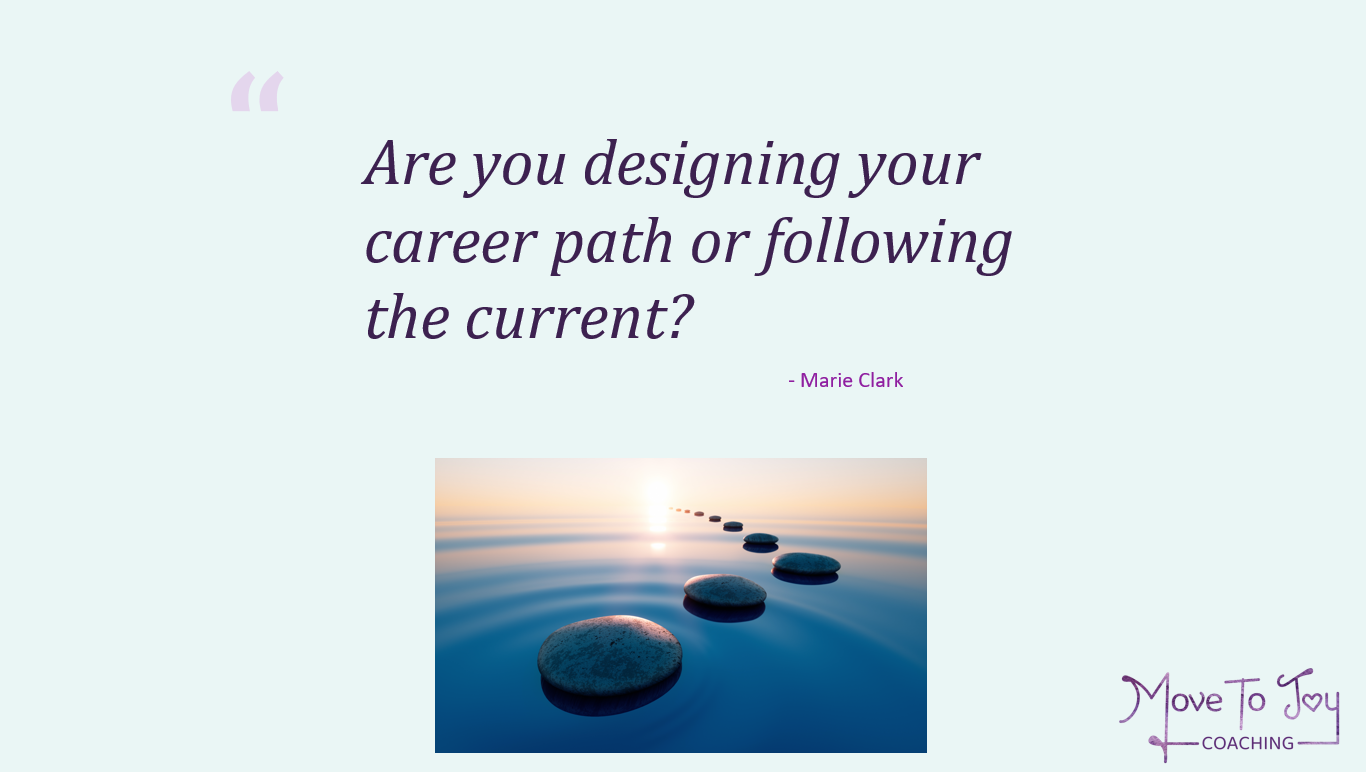
That's not a career path. That's a current.
On the surface, Janine's trajectory looked like progress. But without structure and intentionality, progress on a treadmill is still a treadmill.
What Well-Sequenced Actually Looks Like
Here's what most career advice gets wrong: it treats a career transition as a job search problem. Find the right opening. Update your résumé. Network harder. But the real challenge — the one almost no one addresses — is breaking the cycle that led to burnout in the first place.
Because if you don't understand why you burned out, you'll rebuild the conditions for it in your next role. Guaranteed.
The work I do with clients through the M.A.P. Process™ is built around this premise. It's a structured, three-stage framework for women who are ready to stop defaulting and start deciding:
Uncover what actually drives you — not what you were told should motivate you, not what made sense when you were 25, but what genuinely energizes you now
Map a vision that's genuinely yours — a clear, honest picture of what a fulfilling career looks like for your specific life, not a generic "purpose" exercise
Build a transition plan that accounts for real life — mortgage, family, stability, all of it; this isn't journaling, it's decision architecture for people with real stakes
What looks effortless from the outside is almost always well-sequenced behind the scenes. The sequence is what most people skip.
From Exhausting to Focused
With Danielle, we started simply: identifying the 20% of her work she still genuinely loved. From there, we mapped what a role built around that 20% would actually look like in practice — the kinds of problems, the kinds of teams, the kinds of environments where she'd do her best thinking.
Her job search transformed. Not because she suddenly tried harder — but because she stopped trying randomly. Scattershot effort became a focused, well-designed career shift. She landed in a role that fit.
With Janine, the process looked different but followed the same logic. The M.A.P. Process™ revealed two distinct paths she hadn't considered — and for the first time in years, both genuinely excited her. She started pursuing them simultaneously.
Then something familiar happened: a former manager recommended her for one of the roles.
But this time was different.
Instead of being carried into a position, she chose it. Same outcome on the surface. Entirely different relationship to it underneath.
That's what structure does. It doesn't remove opportunity — it changes your relationship to it. You stop being lucky and start being deliberate.
The Question Worth Sitting With
Precision is not rigidity. It's intentional design.
When the sequence is clear, the outcome becomes more predictable — and more yours. Not yours because you found the right opening at the right time. Yours because you built the conditions for it.
The question most high performers are asking themselves is: Am I trying hard enough?
The question that actually moves the needle is: Am I building a career by design — or just surviving a well-paying one?
If you're a woman in corporate IT, Finance, or the Sciences — and you have a quiet sense that something is off, even when everything looks fine on paper — that feeling is worth listening to. It's not a sign that something is wrong with you. It's a signal that something is ready to change.